Getting Around Perfection

"Have no fear of perfection - you'll never reach it." ---Salvador Dali
We don't have a lot of choice in the way we think. Not really. Life is a series of experiences, the vast majority of which we have no control over. Life just rolls right along without stopping to acknowledge us. The times we do have a say in what happens in life are few and far between, and for most of us that doesn't even get started until after we leave home for the first time---for some of us it takes longer still, longer to understand who we've become. But well before that time, our brains have already been formed. Strong connections have already been established in our brains, making us timid or brave, sociable or introverted, and so on. Some people are too needy. Some people are too greedy. And worse: some people get it in their heads that perfection is what it's all about. Perfection. That sweet idyllic metaphor, humming with the unseen rhythms of the universe, that one pure note of absolute mindfulness to which the very insects tune their lullabies on crisp moonless nights beneath the stars.
Hogwash! There's no such thing as perfection. Not really. Even if there was, would you really want that? At what cost? Yes, we can achieve sublime moments when everything seems to work out, and we might take a pause in those moments (if we are lucky) to acknowledge the "perfection" we have achieved. But those moments are seldom appreciated, and, sorry, it's not really perfection. This is what I think. I think perfection (or the perfection-obsessed mind) is an obstacle. It is in the way. It halts creativity. It stunts growth. It prevents people from learning and improving. Yes, a perfectly executed work of art is a thing of beauty---I'm not saying that can't or shouldn't be achieved---but the approach must be done in a healthy way. Perfectionism is a mind-trap. It is a mad cycle of desire to succeed, fear of failure, anxiety over the smallest mistakes, and finally, when the perfection hoped for has not quite been achieved, an ultimate letdown.
"For perfectionists, life is an endless report card on accomplishments or looks. It's a fast track to unhappiness, and perfectionism is often accompanied by depression and eating disorders. What makes perfectionism so toxic is that while those in its grip desire success, they are most focused on avoiding failure, so theirs is a negative orientation. And love isn't a refuge; in fact, it feels way too conditional on performance." ---Psychology Today
So how do we get better at getting better without the perfectionism baggage? I answered my own question there: without the baggage. Leave perfection to the insects---let them have it, and all the problems that go with it.
Practical steps? Here's an idea: take some paper or canvas or surface of your choice and some pens/paint/charcoal/etc, and practice shutting off your brain for a little while. Close your eyes and maybe start by drawing or painting a circle---just quickly, without thinking about it. Okay, you can look at it, but then close your eyes again and repeat the circle thing. There, you've done it---two circles. Is it perfect? (if so, you may not be human; if not, congratulations, session complete) What comes next? I don't know---I'm not the boss of you---keep doodling, perhaps. Find some way to be creative without relying so much on your brain. Over time you'll develop new pathways in the brain---or maybe not (I'm not a doctor)---you will find your way out, I'm sure of it. Meanwhile, don't sweat it. You're doing fine. You are perfect just the way you are.

Earthbound
another slow river
This is an image I've painted a few times now---something haunting about it, if I do say so myself. This is Algiers Point in New Orleans. See the painting process video below.
Slow River, 36x48", $1400 (no. 1039)
vaughen's lounge
Vaughen's Lounge is located in the Bywater area of New Orleans. I painted this from a reference photo I found online. It took me around two hours to complete. I like the cartoonish aspects of the piece (ie. the poles on the right) and the red-orange rust of the tin roof. Upon further consideration, I think I prefer paintings like this---paintings of real places rendered in an interesting style---paintings that evoke a memory of a place in time. See painting process video below.
Vaughen's Lounge, 36x48", $1400 (no. 1038)
painting process: three cabins
Another painting process video. Three Cabins, 5x7", watercolor, $50.
painting process: cooper
This was a recently commissioned pet portrait of a Boston terrier named Cooper. If you're interested in commissioning a painting of your own, see my pricing page for more info. Enjoy!
Fuel to the Fire
I've been writing some on a new book about art---my take on it anyway---and I thought I'd post a section of it here. It's just a first stab at the topic and will probably change in its final form, if and when the project ever gets finished. Enjoy and please leave a comment if you have anything to add on the topic!
Fuel to the Fire
When I stand at my easel and paint, I recall a simpler time. A time half-forgotten. When I paint, I remember what it was like to play, what it was like as a child to imagine worlds within worlds and to speak them into existence. To negotiate imaginary battles. To summon heroes. To build castles out of sand and place oneself on the ramparts yelling down to a plastic action figure in a friend’s hand: “Who goes there?!” To hear him reply in an altered voice, “It’s me!” To respond in turn with the inevitable question, “What’s the password?!” (and then the fantasy would be paused as we played twenty questions to resolve the issue)
It’s not that when I paint I think about the details of my childhood—-I do not—-but it’s the essence of that time: echoes of a mind untethered, a discovering mind, a creative mind. When I paint, I am unburdened and set free of distraction and worry. I am an instrument of intuition. I am pulled out of time. I have come unstuck. The brush moves; it scrapes against the canvas, leaving behind a trail of paint—-all that is true but for one detail: I move the brush. The artist wields the power, makes the decisions, creates worlds within worlds and speaks them into existence. The artist is in charge.
When I stand at my easel and paint, I often listen to music. I assume this is true of many artists in many different disciplines. Music has a way of pushing away the real world and redirecting the mind to a more creative space. I find that to be true. It’s not magic and it’s not altogether automatic, but it does seem to help. And any type of music will work, I’m sure. I don’t normally listen to country music, but I’m pretty sure if I played country music when I painted it would do the job just fine. I have tried classical music and I have tried music from the eighties as well as “oldies but goodies.” I have listened to entire albums from single bands—-Simon and Garfunkel, The Beatles, Radiohead, Beck—-and I have let the radio play down the top 40 hits while I’ve painted. It all seems to work just fine. However, in the interest of honesty and in full disclosure, I should tell you that I paint most of my paintings to angry music.
There is something to be said for the raw passion and unbridled energy of punk and post-punk alternative music—-maybe sprinkled with a bit of metal and a bit of grunge and even a bit of post-ironic garage band thrown in the mix. I like it. I can nod my head to it. I can paint to it—-and I often do! Nothing beats a wall of discordant power chords fed through the right distortion pedals and tube amps complete with microphone feedback and lyrics belted out in bold abandon—-you can almost see the sweat spraying off the brow of the lead singer as she bounces to the frantic rhythm unconcerned with reality as she knows it. Nothing beats the isolation this creates as the raw energy is radiated out like some undiscovered thing that kindles the fire of creativity. It washes over me and passes right through me as I stand at my easel to paint. And I use this energy best I can. I channel it onto the canvas—-it becomes a rich landscape; it becomes a delicate flower; it becomes the face of a portrait; it becomes art. Art creating art.
There is a bit of chaos to the music. There is something dangerous in it. An idea that goes against the grain. No, I do not subscribe to the idea of nihilism—-my paintings might be amoral but I am not—-but there is something primal to the energy that music can project (now I’m sounding all New Age-y). I guess I’ll just leave it there: music injects energy into creativity.
Materials and Equipment of an Artist
Since I've been doing videos lately, I thought I'd switch it up from my painting process to the materials and equipment I use as part of that process. In case you're interested.
dog portrait, the process
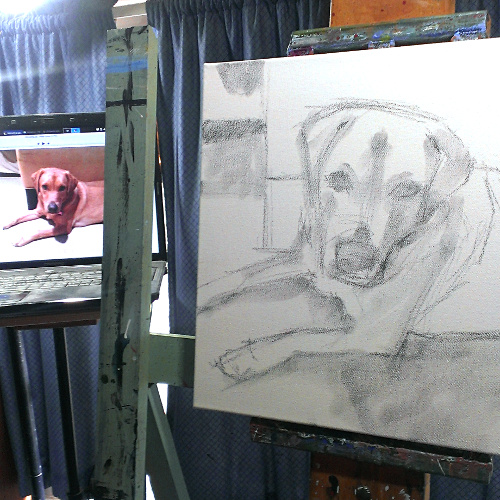
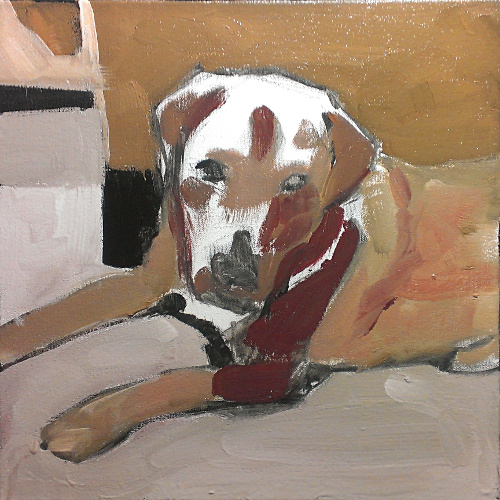
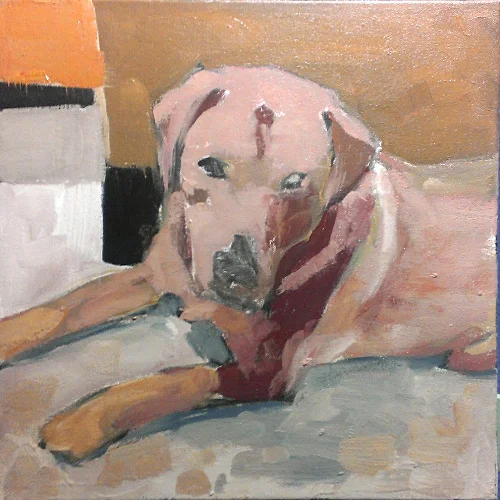
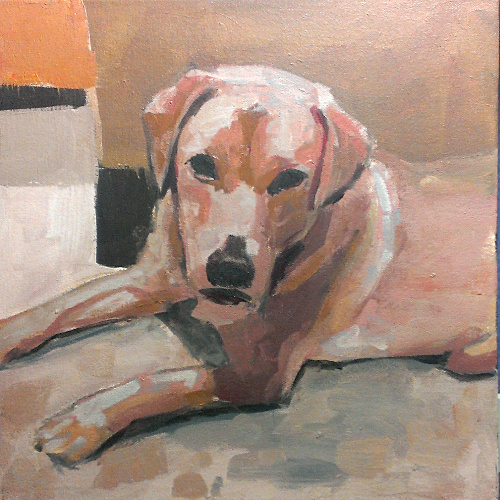
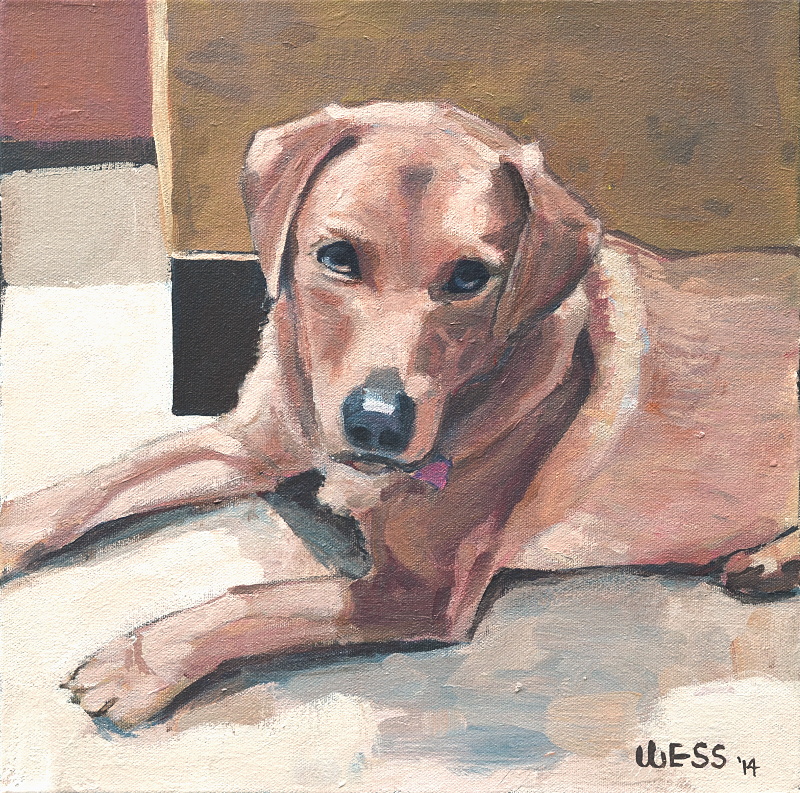
Another dog commission. This time I took snapshots along the way. Enjoy (and forgive all the "thens").
I started off with a pencil sketch, something which I don't typically bother with. Then I traced over the soft graphite with black paint. Then began filling in with color, starting with mid-tones, then with the lighter, highlighted areas. The second to last shot is nearly to a finished state but does not look close enough to the subject in the reference photo---all that's left is details. Final shot is the finished painting.

bulldog painting process
This is a commission I painted a few months ago. I took photos along the way and thought I'd share a bit of my painting process for you here.
First off, the reference photo. Here's the photo I was working with. Ideally, the photo should encapsulate the basic layout of the painting itself. Photography after all is an artistic pursuit in its own right. This photo was taken in landscape but I want a portrait-oriented canvas---not so bad as this was the only major change I needed to make.
I usually don't make a drawing before starting in with the paint. Here my main goal is to cover the canvas with paint---I am trying to capture the placement of the subject but only roughly [and knowing I will be changing and perfecting anything I paint at this stage].


Once the shapes are roughed out and the canvas is covered with paint, I start the process of reshaping the form into something more akin to the photo. The client wanted a nondescript background with vibrant reds and yellows, so I laid it on thick, adding dramatic lighting by suggesting shadows on the ground [notice, there are actually little if any indications of a light source on the dog's body itself---if I wanted a more realistic representation, I would definitely address this issue perhaps by retaking reference photos with a light source coming from the left].
I usually do not like to leave dead spots in my paintings---places where there is a single unvaried color---notice how the white of the chest and the tan of the back are both mottled with gray, indicating fur and making those areas more interesting. And of course, the background is a mishmash of undulating color.
I am pleased with the final painting, though it took a bit of time toward the final stages getting the details right. I focus most of my attention in the later stages on the face, since this is the focal point of the painting and the focal point is where most of the details should reside. Other important parts of the painting---the carefully attenuated feet and the dramatic shadows beneath those feet---make the entire surface of the painting important to the viewer. The eye moves from the focal point to the interesting background, to the feet and shadows, then return to the features of the face.


Sed diam nonummy euismod tincidunt ut laoreet dolore magna aliquam erat volutpat.